Shape the engagement
Bring the client question, discovery, proposal and scope into a clear starting point for delivery.
Scope and handover Build n Bloom
Sollerius connects your people, knowledge, agents and workflows across the work of your firm.
Shape new engagements, put agents to work on research and analysis, coordinate delivery and client follow-through, and carry useful knowledge into the next job. Build around the way your firm works, with clear responsibilities at each step.
In development · Availability
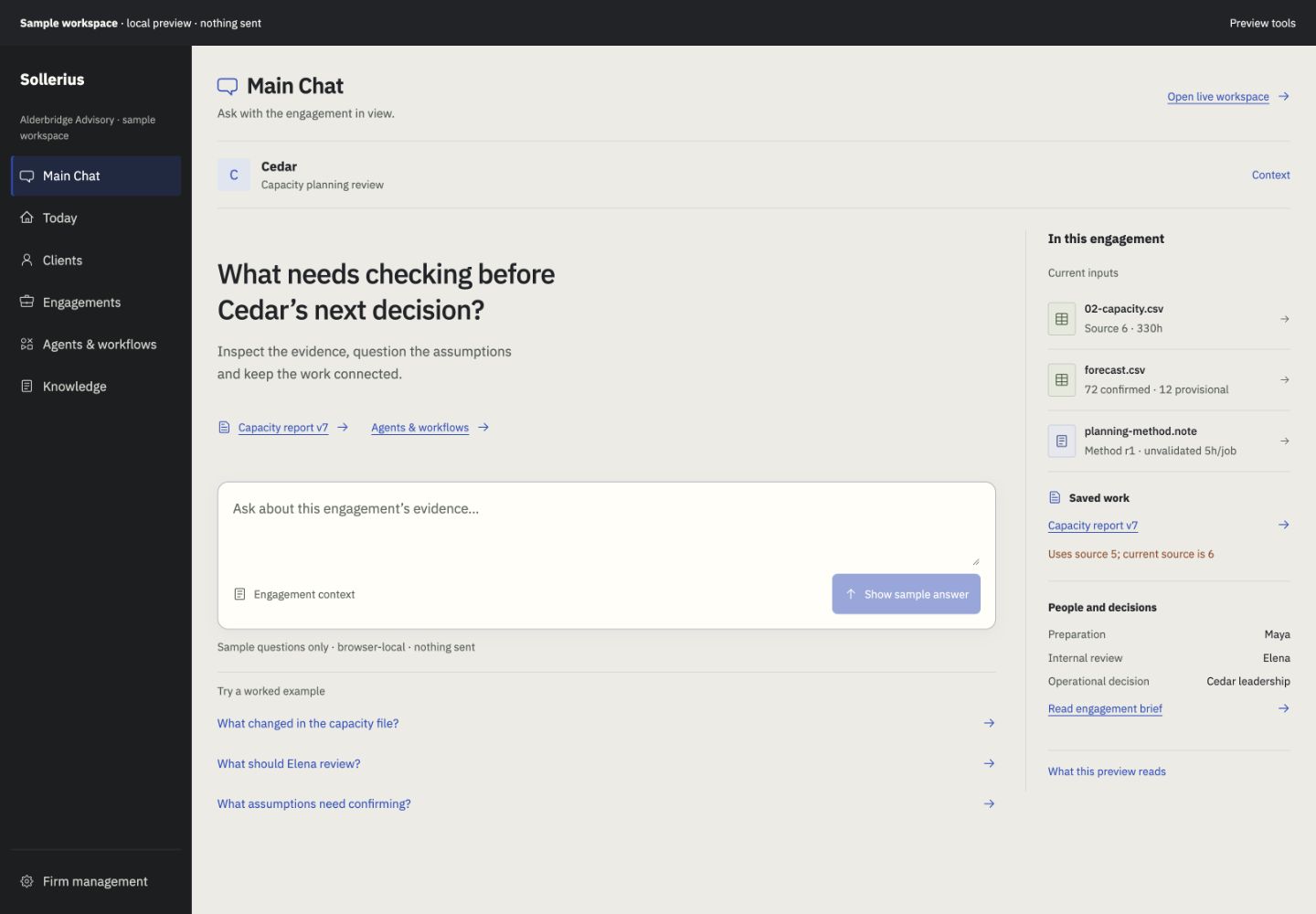
A client brief should not lose its context when it becomes a proposal, an engagement or a handover. Sollerius brings the jobs around that work together, with agents and workflows grounded in your firm’s knowledge.
Bring the client question, discovery, proposal and scope into a clear starting point for delivery.
Scope and handoverConnect evidence, analysis, working papers and review around the service your client is paying for.
Delivery workflowsCarry meeting decisions into next actions, respond with the engagement in view and revisit what the client needs.
Client workflowsBring capacity, scope, effort and billing readiness into the operating decisions behind the work.
Firm workflowsKeep useful precedents, improve your methods and investigate services worth adding to your practice.
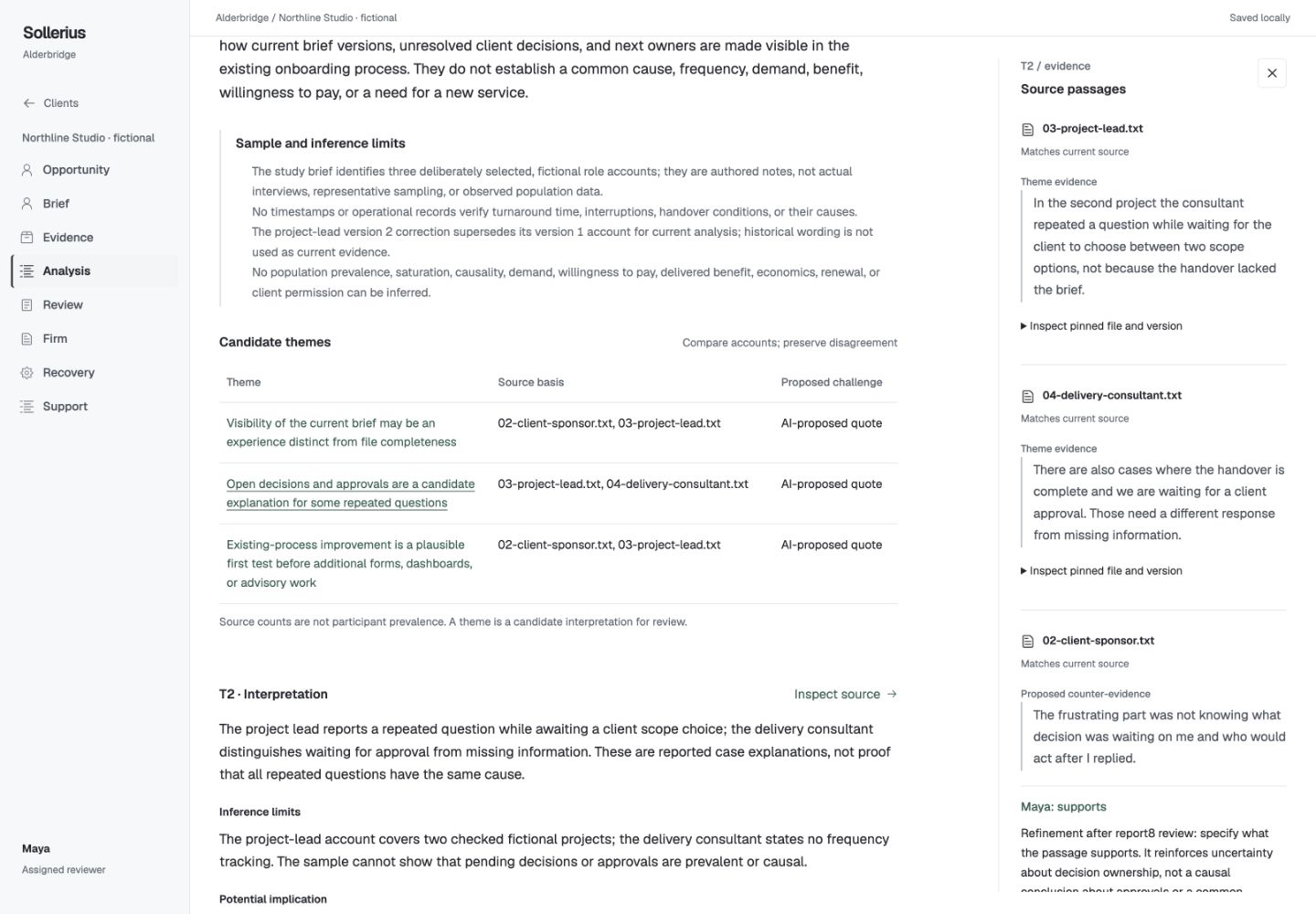
Practice workflowsBefore a reviewer can challenge a recommendation, the team has to find the relevant passages, compare accounts and explain how the draft reached its conclusion.
 Opens the full capture in a new tab.
A passage in the source material
“I could not tell which version the team was using.”
Does uncertainty about a file version conflict with an account of complete handovers?
The reviewer’s correction
In the Northline workspace, Maya separates the sponsor’s uncertainty from the project lead’s account of complete handovers. The agent prepares the comparison. Maya decides what it supports and changes the wording.
Evidence — 02-client-sponsor.txt: I could not tell which version the team was using.
The sponsor’s version uncertainty and the lead’s report of complete handovers concern distinct aspects of the process. The lead passage challenges a missing-information explanation for two cases; it does not contradict the sponsor’s experience or the distinction made in this theme. Treat its relationship as qualified rather than as an opposing account.
Reason and limits: Fresh method2 run still uses the same lead quotation as both support and counter-evidence. Human review distinguishes the claim being challenged from the theme itself. This is a new run-specific judgement, not an automatic carry-over of the earlier T1 correction. Three authored accounts establish no frequency, cause or demand.
Read report reasoning beside the exact sources selected for that saved version. If a current source differs, a fresh review is required before anyone relies on the report again.
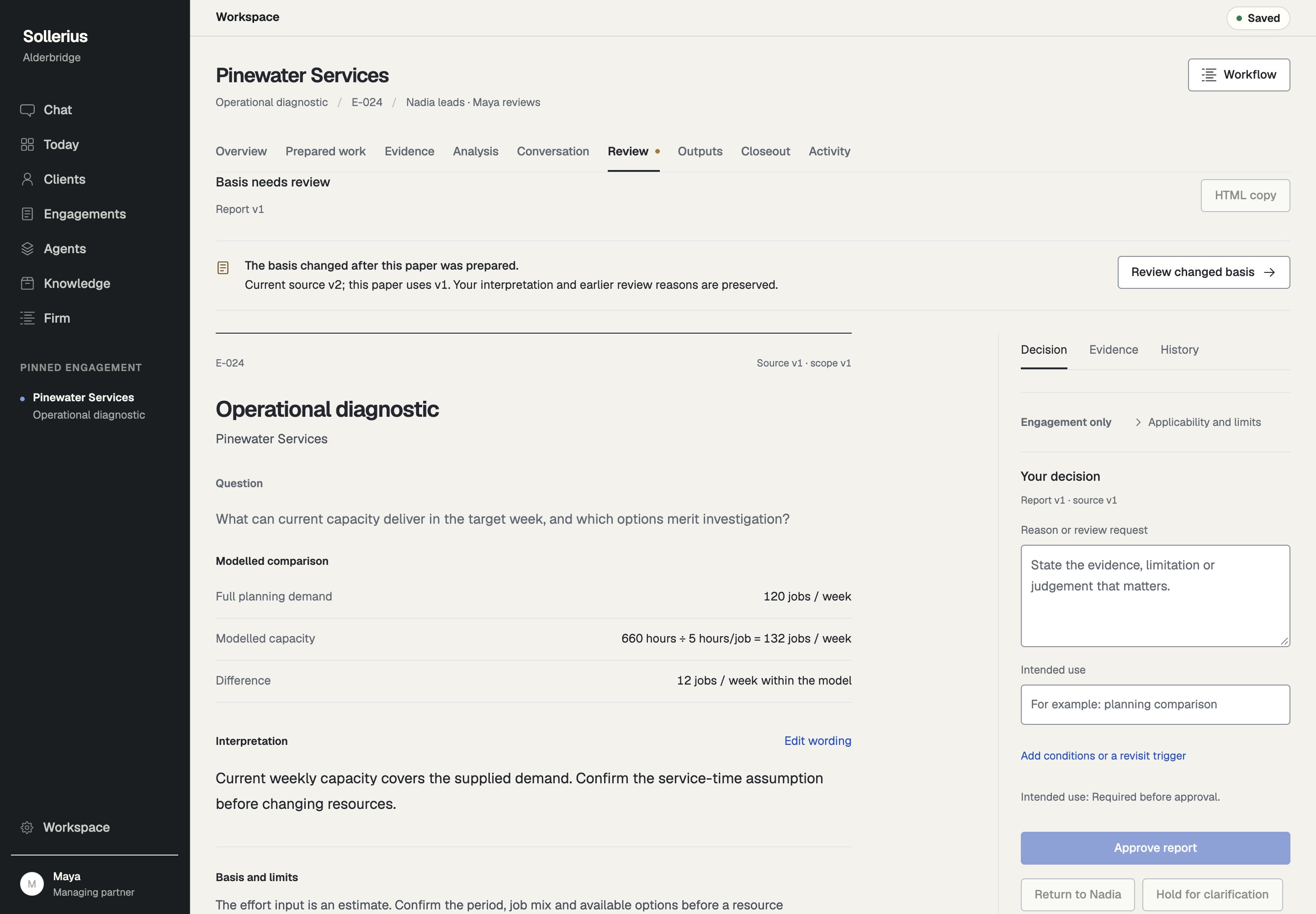
Saved report inputs
Keep report reasoning and its selected input version together. The next person can check what was saved before deciding how to use it.
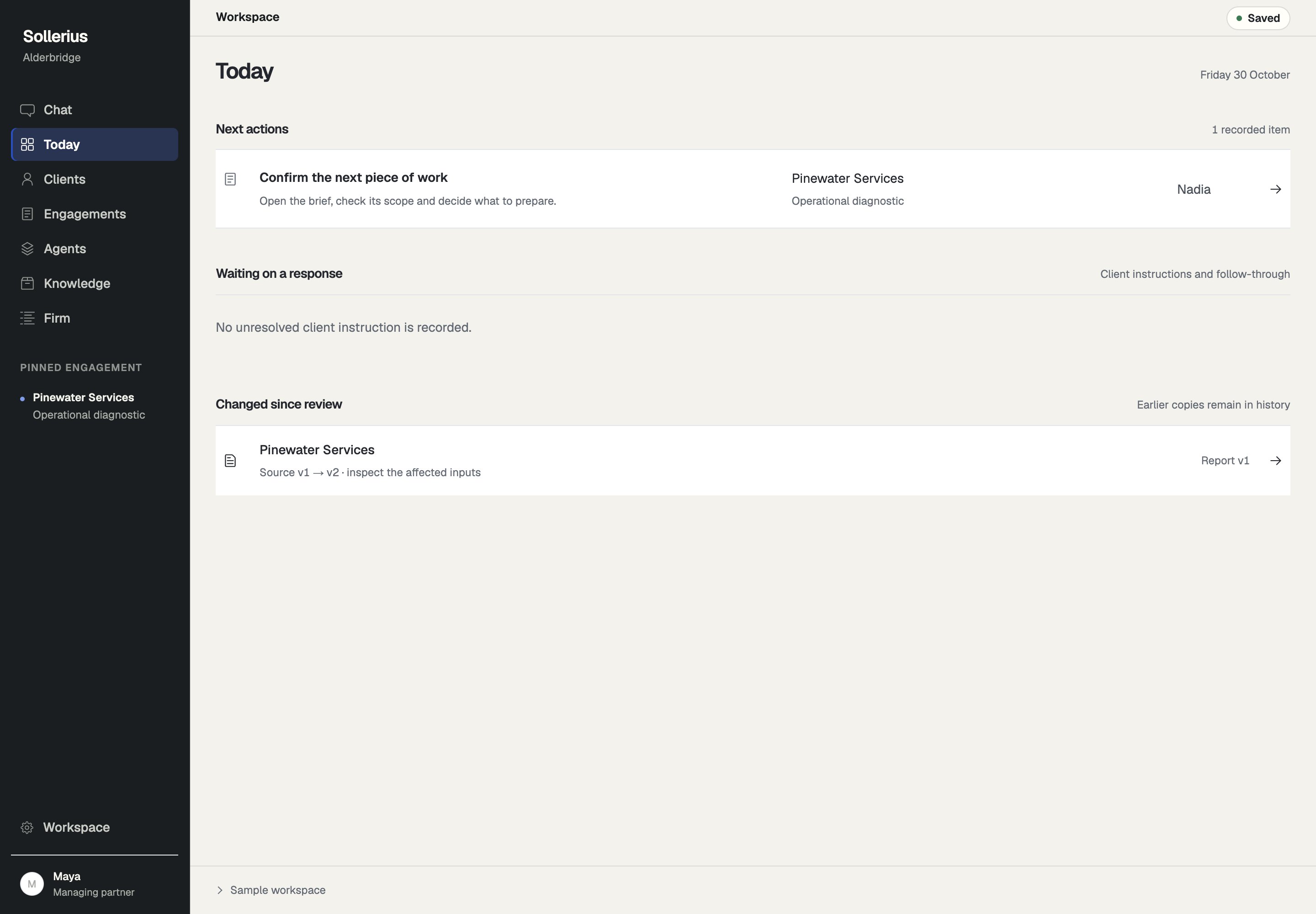
Current source inputs
Current source v2 is distinct from source v1, which the saved report was prepared from. The earlier record remains available, while the change makes the need for a new review visible.
These product views use sample engagement data. We agree the AI actions, live connections and review steps as part of your implementation.
Turn a useful lesson into new guidance for the firm. Keep private case notes separate, and check the rights, purpose and limits of any material proposed for reuse.
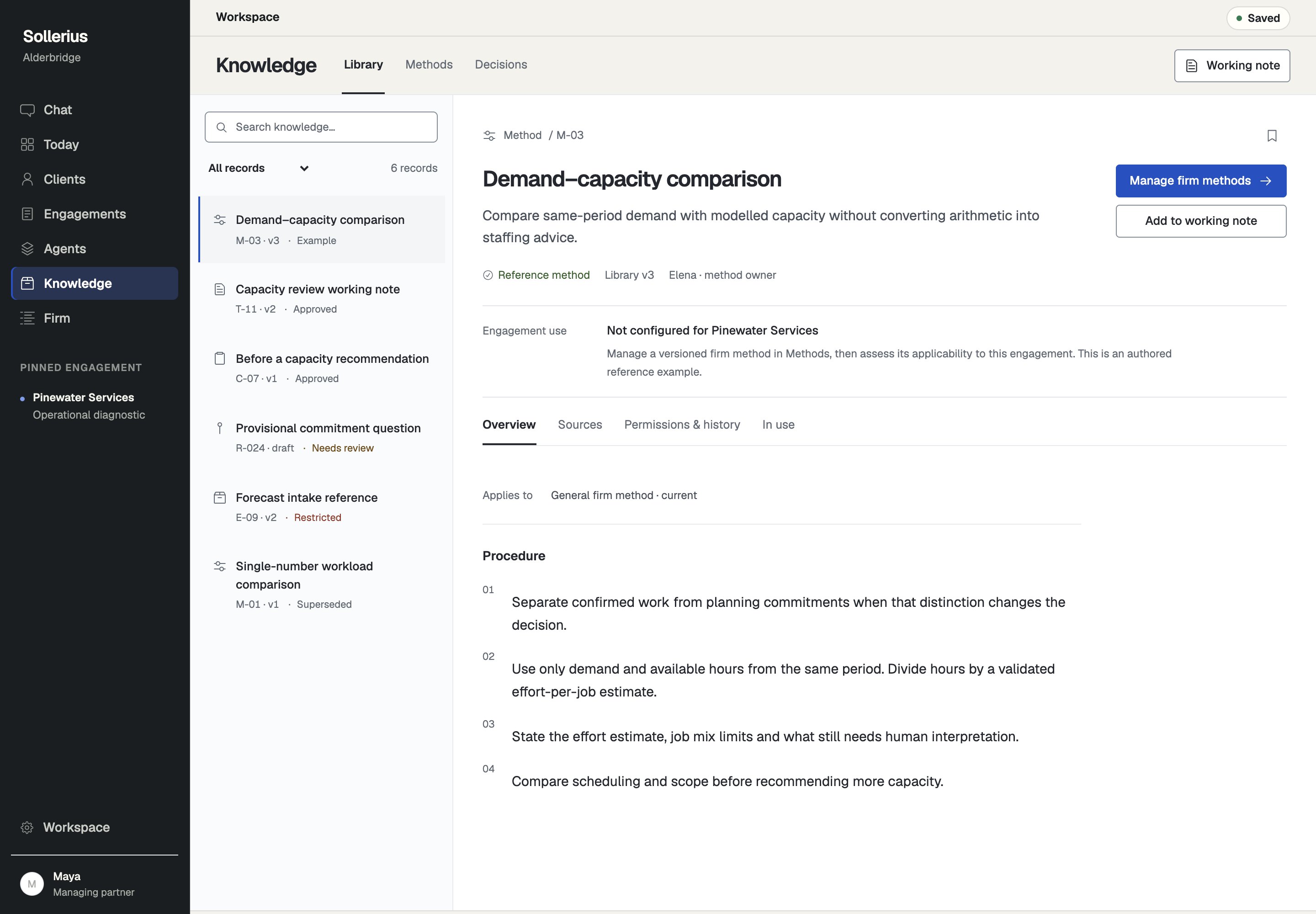
Follow the source version, saved report, professional review and release record without treating a private case note as firm-wide knowledge.
The permitted precedent set is limited to owned sample firm methods; the knowledge search returned no other permitted entries. The closest fit is the Cross-case interview synthesis method, version 2. It fits because the present question is not whether a service should be launched, but how to compare selected role accounts while keeping a reported experience separate from a causal explanation. It transfers four usable disciplines: quote-linked candidate themes; visible source roles; a specific explanation of what any apparently contrary account challenges; and an explicit limit on prevalence, causation, demand and value claims.
1 more saved passage in the file.
A professional review does not establish issue, client receipt, client acceptance or finance readiness. Each is a separate record and decision.
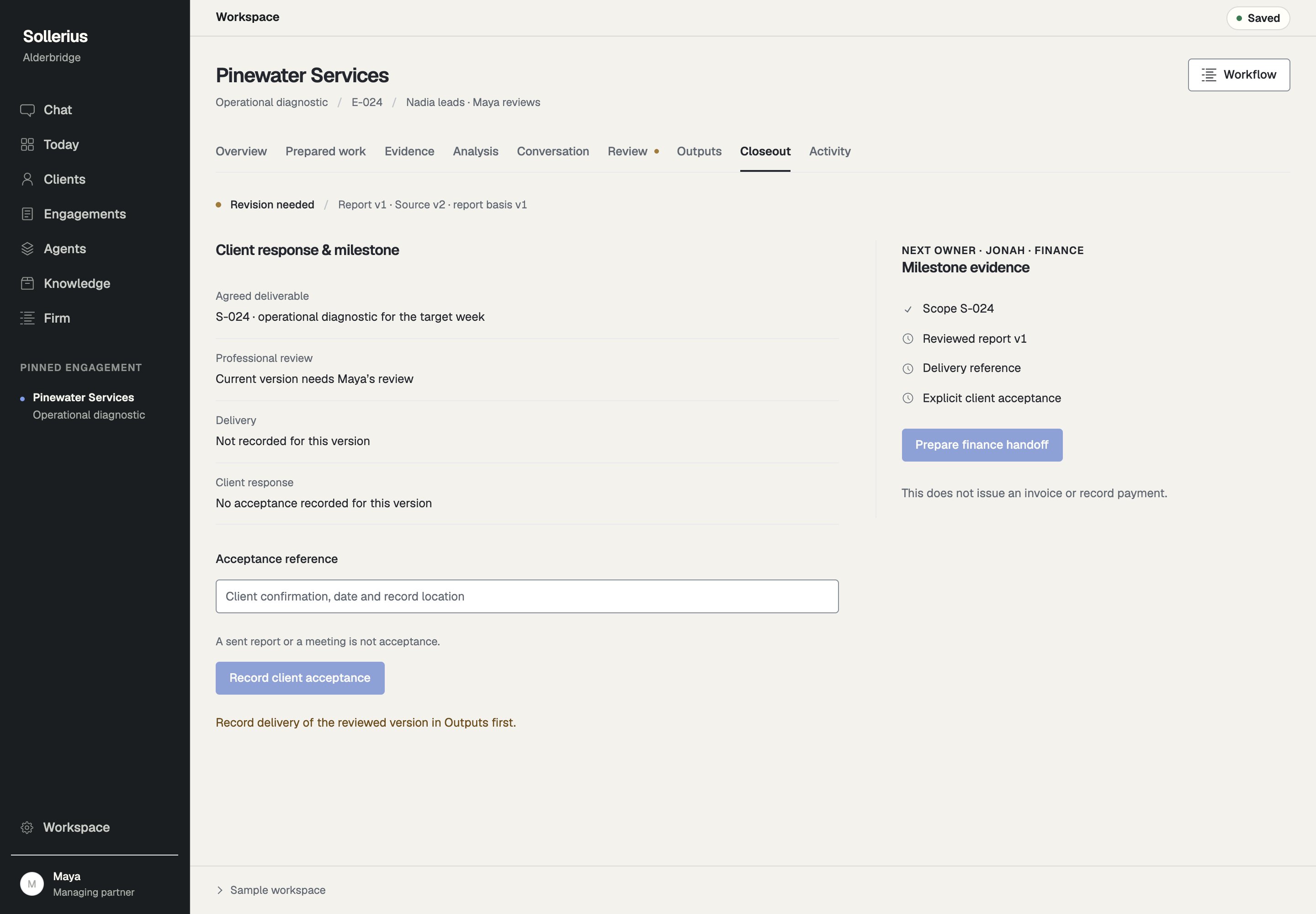
The work behind a client commitment includes analyst time, reviewer availability and changes in scope.
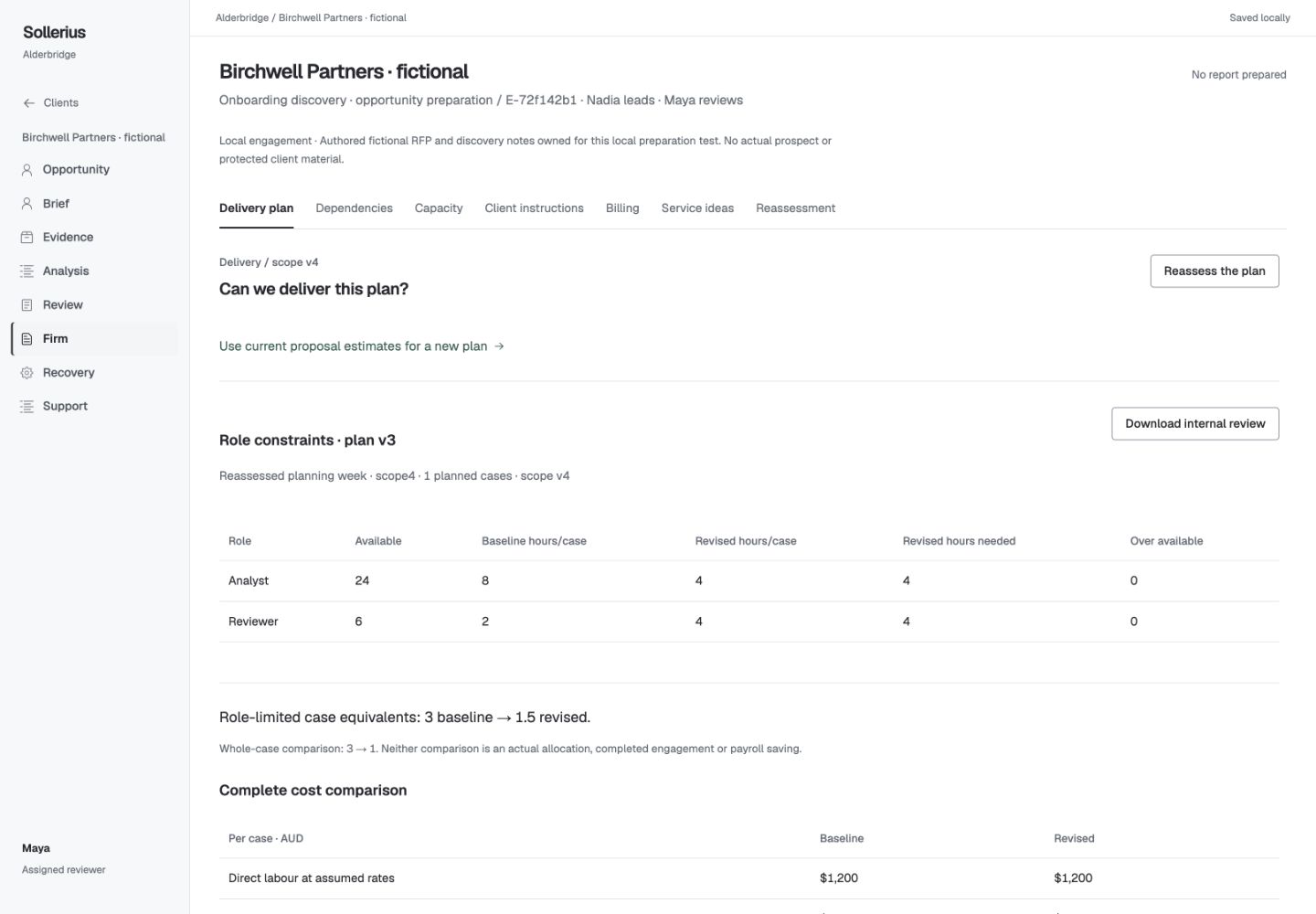 Opens the full capture in a new tab.
Start with the job, the inputs it needs and the result your team expects. Inspect the responsibility and see where a person takes the next decision.
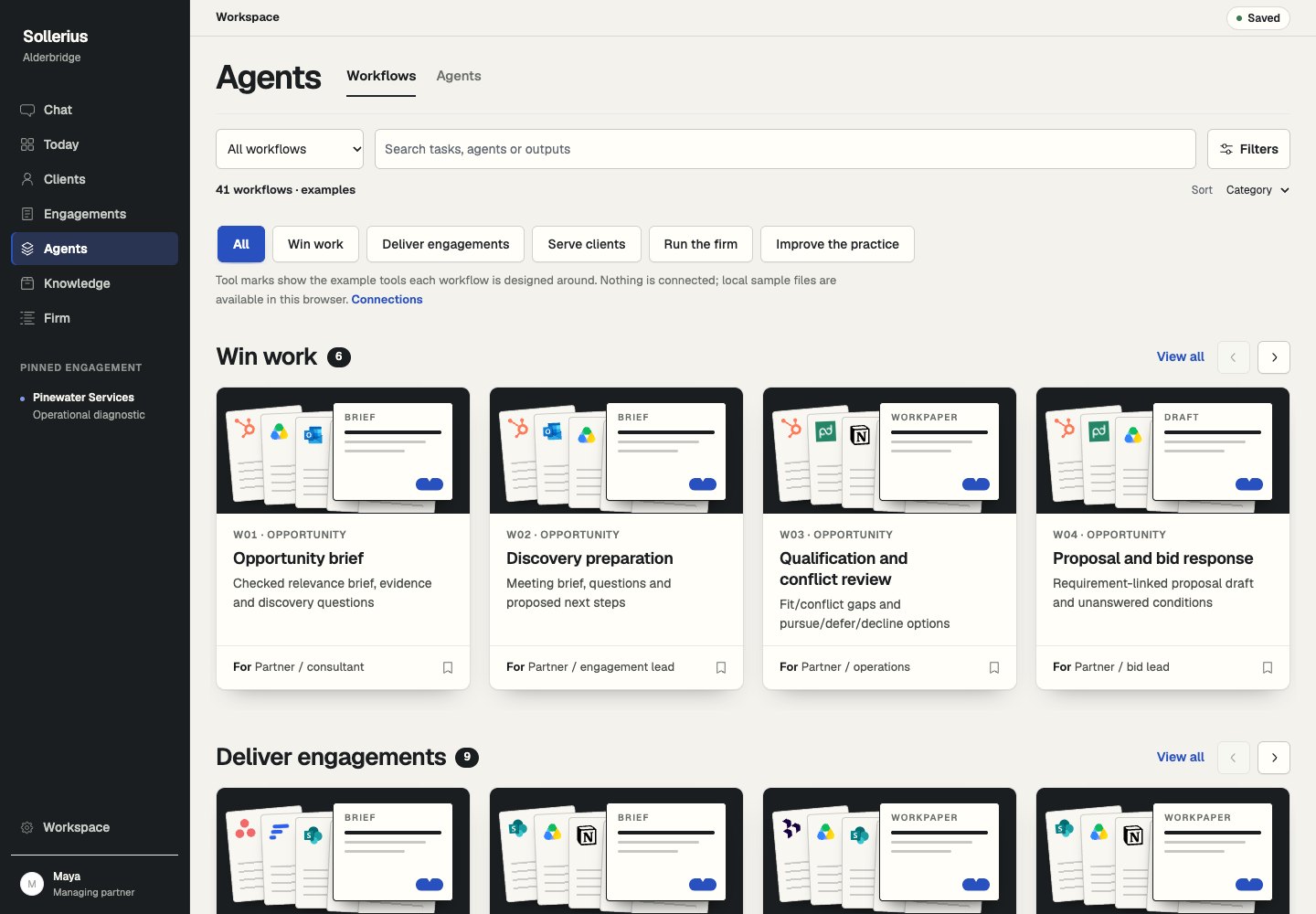
All 36 capabilities in seven groups. Each one states what it helps your team do, its current scope and the evidence behind it.
Keep the original question in view as the work moves between people.
Keep the client question, brief, evidence, analysis and decisions attached to the same engagement, so the next person can pick up the work with its context.
Demonstrated locally. Local sample demo only.
v37–v48; workspace-wide production collaboration remains unverified.
Give each engagement its own scope, sources and saved work. Start cleanly without copying another client’s material into the next job.
Demonstrated locally. No multi-tenant production claim.
v37/v43/v47/v48; authenticated grants tested separately.
Bring the requirements, deliverable, exclusions and fee assumptions into the internal delivery handover. Revisit them explicitly when the request changes.
Demonstrated locally. No commercial-result claim.
v43; external agreement, CRM and e-signature remain separate.
Keep prerequisites, named owners and dates together. Distinguish an internal target from a client promise and show which later work depends on it.
Demonstrated locally. Broader plan is partial.
v40/v44/v45; internal targets, client promises and billing conditions stay separate.
Record the client instruction, its conditions and the follow-through it needs. Keep it distinct from an internal review or an assertion of client acceptance.
Demonstrated locally. Not automated communication.
v45 local simulation; no actual client message, consent or external acceptance is inferred.
Prepare discovery, proposal scope and fee assumptions from the actual service and its delivery needs. Carry the internal decision into the handover.
Local opportunity-to-handover preparation demonstrated. This does not establish signed terms, a client win or an external CRM update.
v43 W01–W06; no external CRM write, signed contract or sales outcome inferred.
Use evidence and a chosen method to prepare analysis, then test what it supports.
Prepare a substantive working analysis using the brief, selected permitted evidence and a chosen firm method. Your team tests the interpretation before relying on it.
Demonstrated locally. Your team remains responsible for interpretation, quality and completeness.
Capacity and qualitative paths received; provenance does not establish semantic correctness.
Bring possible rival explanations, missing evidence and uncertainty into view, so the reviewer can challenge the first account rather than simply polish it.
Demonstrated locally. Does not guarantee completeness.
v42/v46; exact-quote and semantic-relationship checks are distinct.
Calculate supported comparisons separately from generated prose. Inspect the labelled inputs and assumptions before using a scenario in a decision.
Supported calculations demonstrated locally; wider operating work is partial. Supported calculations only.
v36/v43/v44/v45; new v49 cash/licence calculations have targeted checks, whole operating workflows paused.
Bring permitted CSV, text or Markdown evidence into the engagement with a record of its purpose, version and contents.
Demonstrated locally. CSV/TXT/MD only; no PDF/DOCX/XLSX import.
CSV/TXT/MD case import received; private v49 firm-input two-file admission also recorded. Native PDF/DOCX/XLSX import and live cloud-file connectors are not established.
Check incoming records for missing fields, duplicates and inconsistent identities. Resolve exceptions without silently overwriting a valid earlier source.
Demonstrated locally. Local scope.
Quoted CSV and BOM support repaired in v48; exact reversals retain lineage.
Correct the wording, review the exact version and take an ordinary editable deliverable forward.
Edit the professional wording in your own voice and keep it separate from suggested AI text. Preserve earlier working copies when the basis changes.
Demonstrated locally. Human responsibility remains.
v39/v41/v45/v46; source or wording changes require fresh review.
Record whether the exact saved version is approved, returned or held, with the evidence and method it used. A later change calls for a fresh review.
Demonstrated locally. Not client acceptance.
Internal review does not assert client acceptance or commercial readiness.
Take the exact reviewed wording into an editable Word document, with its evidence and review context available for the next person.
Demonstrated locally. Editable Word output is supported; native Word import is not.
v38/v39/v41/v46; Word export does not imply native Word import or client issuance.
Keep a readable HTML copy of the reviewed report and inspect earlier versions when you need to understand what changed.
Demonstrated locally. Readable HTML reports and version history; PDF output and a full document store are not established.
Local report paths received; this does not establish PDF export or publication.
Identify work whose evidence, method or scope has changed. Prepare a new version for review while keeping the earlier wording and decisions available.
Demonstrated locally. Human reassessment required.
Restoring identical source bytes does not silently revive approval.
Keep the reason behind a correction. Decide which methods and learning the firm can reuse.
Use an owned, versioned method in the engagement. Explain why it fits this question and keep the method owner’s approval separate from the report review.
Demonstrated locally. Human ownership and quality remain required.
v41/v46; firm approval and engagement applicability have separate versions.
Record what the interpretation got wrong and why the professional correction matters. Use selected examples to prepare coaching or propose a method improvement.
Demonstrated locally. Method promotion requires approval.
v46/v47; no employee scoring, automated competence assessment or proven training outcome.
Keep private case material separate from selected reusable text. Record its origin, owner and permissions before making it available beyond the case.
Demonstrated locally. Permissions must be configured.
v47; withdrawal blocks future availability/export but cannot recall prior downloads; rights are user-recorded.
Carry an observed correction into an owned method revision, then use the approved revision in a fresh preparation. Review reusable learning separately.
Local learning mechanisms demonstrated. Method revisions and reuse require human approval; model training is not automatic.
v46/v47; no automatic model training or automatic method approval.
Include reviewer effort, delivery dependencies and commercial conditions in the comparison.
Compare analyst and reviewer effort separately. See when a different role becomes the constraint instead of treating all available hours as interchangeable.
Core demonstrated locally; broader review is partial. Scenario, not capacity guarantee.
v44 core received; W20 whole capacity/pipeline review remains paused.
Identify when a scope change makes the resource plan out of date. Keep the earlier assumptions and prepare a revised plan before making another commitment.
Core demonstrated locally; broader review is partial. Partial professional job support.
v44; do not silently change the recorded proposal fee or carry actuals into a new plan.
Include preparation, review, correction and other known costs in the service comparison. Keep unknown costs visible rather than presenting an incomplete subtotal as a final margin.
Local scenarios demonstrated. No savings, margin or profitability promise.
v44/v48; cost scenarios are not measured savings, fees, margin guarantees or cash.
Compare a recorded billing condition with the relevant delivery, acceptance evidence and dates before the responsible person decides what is ready.
Demonstrated locally. Not automated billing or collection.
Actual contract terms govern; internal approval is not automatic billing permission.
Compare imported invoices with matched receipts, outstanding balances and reversals. Keep a recorded payment assertion distinct from verified cash.
Demonstrated locally with imported records. Live accounting connections and actual cash require separate verification.
v36/v45; imported accounting assertions are separate from live accounting-provider actions and cash.
Shape the first installation around your services, with clear human ownership and room to investigate new ones.
Bring the proposed client decision, evidence needs, delivery assumptions and a competent current alternative into a service pilot decision pack.
Preparation demonstrated locally. Demand and launch unproven.
v48; positive proactive investigation works without an inbound enquiry; real usefulness/demand/payment/renewal remain unverified.
Combine a shared working structure with your firm’s methods, selected services and ownership. Scope the installation around the work your team needs to do.
Configuration demonstrated locally. Bespoke scope is explicit.
Multiple authored cases tested; this is not proof of production multi-tenant service.
Move between the queue, evidence, working papers, comparisons and operating records in a layout suited to the task.
Current interface checked locally. Practitioner acceptance and a complete accessibility audit remain outstanding.
v50 Opus-guided desktop/intermediate/narrow receiving, bounded keyboard/contrast checks and registry/export preservation. Actual200% zoom, complete screen-reader audit and practitioner acceptance remain unverified.
Open a supported job in its engagement context and inspect the inputs, preparation and result. Keep the next human decision visible with the work.
27 local paths checked; 14 paused. Eight role configurations are inspectable; these are not installed autonomous workers.
41 workflow definitions;8 inspectable role configurations;16 responsibility specifications in the research catalogue. None of those counts establishes deployed autonomous workers.
Compare a bounded improvement with the competent process or tool your team already uses. A useful experiment, a simpler change or no build can each be a sound decision.
Local decision mechanisms demonstrated. Practical usefulness needs assessment with your team.
v42/v48; practical usefulness and buyer acceptance require later evidence.
Make setup, acceptance, handover, remaining obligations and support ownership explicit with your team. Agree the commercial scope for the installation.
Support preparation demonstrated locally. Installation, support responsibilities and any continuing arrangement are agreed separately.
v45; no provider access change, legal discharge, support SLA or automatic retainer.
Discuss the access, onboarding, supported use and responsibilities your firm would need. A separate agreement would define continuing platform access.
Proposed. Continuing access, price, support, renewal and contract terms are not established.
No validated platform price, subscription billing, access contract, paid demand or renewal established.
Give people the right responsibilities and preserve the history needed to resume or reconcile work.
Give owners, leads, reviewers, finance staff and viewers distinct responsibilities, with workspace and engagement access chosen for the work.
Access controls tested locally. Hosted tenancy, SSO and security certification are not established.
v38 and later targeted grant checks; production tenancy, SSO and hosting are not established.
Resume supported local work after a restart with its saved records and histories, rather than reconstructing the last working state.
Demonstrated locally. Production recovery arrangements remain to be established.
v36–v48 receiving; local persistence is not production disaster recovery.
Preview and restore the supported workspace records, then reassess their review state before taking work forward.
Bounded workspace recovery demonstrated locally. The JSON backup excludes separate AI and backing stores.
Backup excludes separate immutable AI/backing stores; complete portable server recovery is not established.
Surface conflicting changes instead of silently replacing valid work. Confirm what was saved before the next review or download.
Demonstrated locally. Production concurrency and load have not been established.
Bounded CAS/retry and save-order tests; no production concurrency/load claim.
Choose a workflow from an existing paid service or a worthwhile service idea. In a guided evaluation, we agree a safe sample, a practitioner and reviewer, and the criteria that would make the result useful. You leave with reviewed findings and a next action.
In development. Examples use sample engagements. Implementations and live connections are scoped separately.
These product views use sample engagements to show how the work fits together. Your build is scoped around the services you deliver, the tools you use and the decisions your team retains.
We design and build around your team’s method, sources, tools and review process. A clear scope can be quoted directly; an optional Blueprint helps when the design needs work first.
Explore a guided evaluation How a build begins