Work through one selected workflow with us, using a safe sample and your team’s review criteria. We’ll record the findings in a Fit Note, delivered at the time we agree.
Choose a workflow from a service your advisory firm delivers, or from a new service you want to investigate.
01
Choose the workflow
Start with a service you already sell or a specific service idea worth investigating. Choose one workflow and one question whose answer would help you decide.
02
Set the review criteria
Name the practitioner and reviewer. Use a fictional sample or expressly permitted, non-confidential material. Agree the criteria, scope and finish before the session.
03
Examine the output
Follow the selected workflow, examine the output and challenge what it supports. Record reviewer corrections, effort and gaps as well as useful results.
04
Record the finding
Receive a provisional Fit Note at the time we agree: what we observed, what remains uncertain and the next action, with an owner and date.
What would your reviewer change?
Read the output as you would a colleague’s draft. Which claims can you check against a source? What is missing or wrong? Decide what needs correcting before the work can be used.
The Fit Note separates what we observed from what your team reported and what still needs checking. The example shows how an unresolved estimate can affect the recommendation.
Illustrative Fit Note. Fictional firm, format only. No buyer reviewer participated.
Harbour Advisory
Sample capacity-review service
Your service and aim
Can AI help compare planned work with available hours, while making uncertain estimates clear?
What we observed
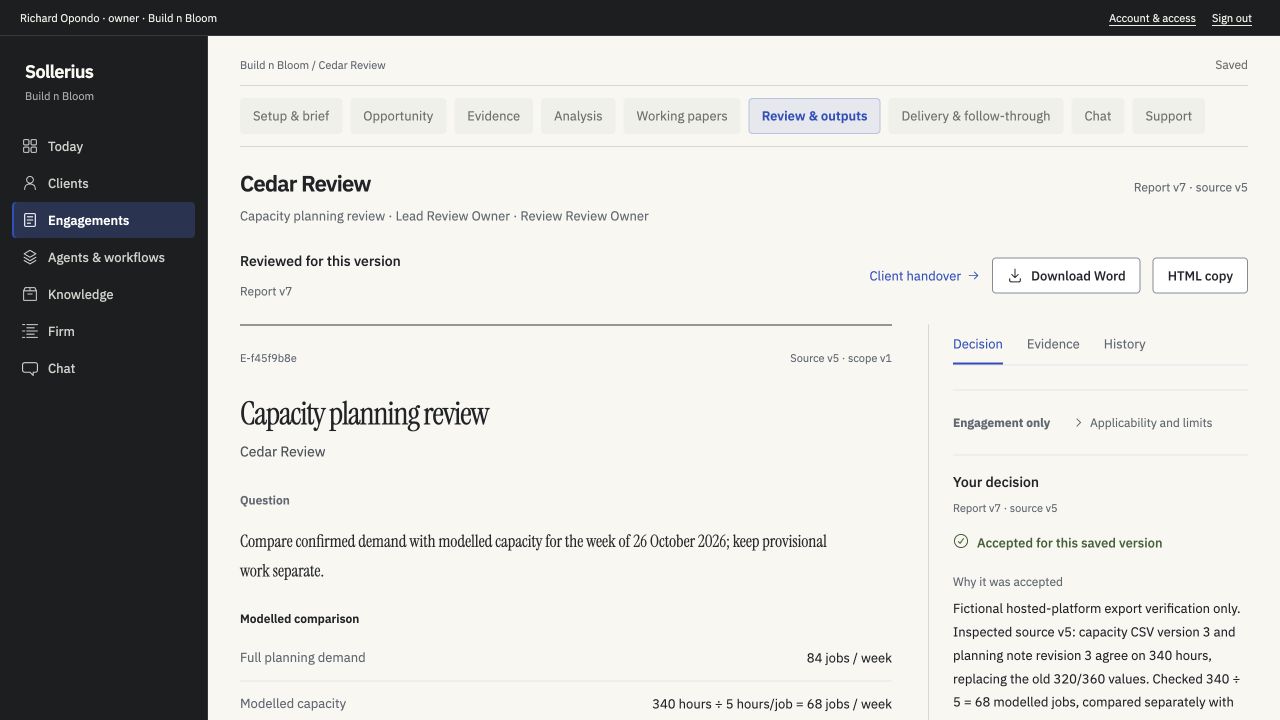
The Cedar demonstration shows report v7 based on source v5, including the capacity calculation and the operator’s review reason. This saved record is separate from the fictional Harbour discussion.
What you told us; what needs checking
In this example, gathering the inputs takes repeated work. The reviewer needs confirmed and provisional demand shown separately, with an explanation of the hours-per-job estimate.
Review decision and limits
Unresolved. The five-hours-per-job estimate needs checking before the comparison can support a staffing decision. No time saving has been measured.
Next action, owner and date
Check the hours-per-job estimate and ask the reviewer what else they need before considering a quote. Owner and date: to be agreed in a real session.
We agree the sample material, access arrangements and any fee before the session.
Material
Start with fictional or expressly permitted, non-confidential inputs. Do not send client records, credentials or confidential files through the enquiry route. Agree any different data handling separately.
Judgement
AI output needs review. The named reviewer checks sources, corrections and fitness for the intended use. Current product recordings and examples use sample data; they are not customer results.
Access and commercial scope
An evaluation invitation does not grant a public trial or account for your firm. We agree the evaluation method, any fee and access terms in advance. If you proceed, setup, access, support and operating costs are covered in a buyer-specific written scope.
After the evaluation
If the findings support proceeding, we can prepare a quote for your firm. If a question remains, we agree how to check it or when to revisit it. A separately quoted Blueprint is an option when design work is needed. There is no automatic installation, subscription or renewal from taking part.
Which workflow would you like to examine?
Tell us about the service, the task and who reviews it. We’ll suggest a starting point.